
In the relatively short history of air travel, the survival of Vesna Vulović, a Serbian flight attendant who fell from an altitude of 33,000 feet, is difficult to surpass as one of the most unbelievable stories ever recorded. On January 26, 1972, JAT Yugoslav Airlines Flight 367 departed Stockholm en route to Belgrade, with a routine stop in Copenhagen, Denmark. While cruising at 33,000 feet over Czechoslovakia, the DC-9 was carrying 28 passengers and 6 crew members, including 22-year-old flight attendant Vesna Vulović. She had been assigned to the flight after a scheduling mix-up with another colleague who shared her first name. Despite the error, Vulović was pleased, as she had always wanted to visit Copenhagen and stay at the Sheraton hotel.
Vulović later recalled, “The last thing I remember is boarding the plane by the rear door and seeing a few women cleaning the plane.” She had no memory of the flight itself. The most widely accepted explanation is that the aircraft was destroyed by an onboard bomb. Vulović remembered noticing a particularly grumpy passenger who checked a bag for the connecting flight but never boarded, leading her to believe the bomb may have been placed inside that luggage. Of the 34 people on board, Vulović was the only survivor. Because she had no memory of the explosion or the fall, investigators had to reconstruct the events without her testimony.
Authorities later determined that Vulović had become trapped in a food cart within the tail section of the aircraft. This portion of the plane separated but remained relatively intact as it fell, eventually landing in a wooded, snow-covered area that helped cushion the impact. Doctors also speculated that her naturally low blood pressure may have caused her to lose consciousness quickly, possibly preventing her from going into cardiac shock during the descent.
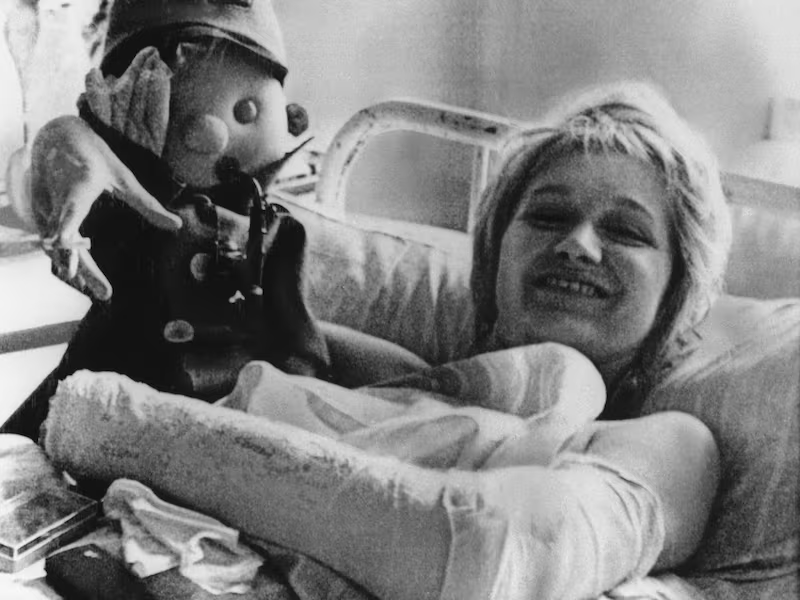
Vulović sustained severe injuries, including:
- A fractured skull
- Two broken legs
- A crushed vertebra
- A ruptured liver
- Several broken ribs
She was rushed to the hospital and underwent multiple surgeries. Despite the extent of her injuries, she survived. The tail section of the aircraft likely provided structural protection during the fall. Unlike the rest of the plane, which disintegrated mid-air, the tail may have acted somewhat like a parachute, slowing the descent. It was also likely tumbling as it fell, which could have reduced the force of the final impact. In Vulović’s case, a combination of structural circumstances, terrain conditions, and extraordinary luck aligned to make the seemingly impossible possible.
I’m SABear and I approve this message


 Life is not a Spectator Sport
Leave a comment