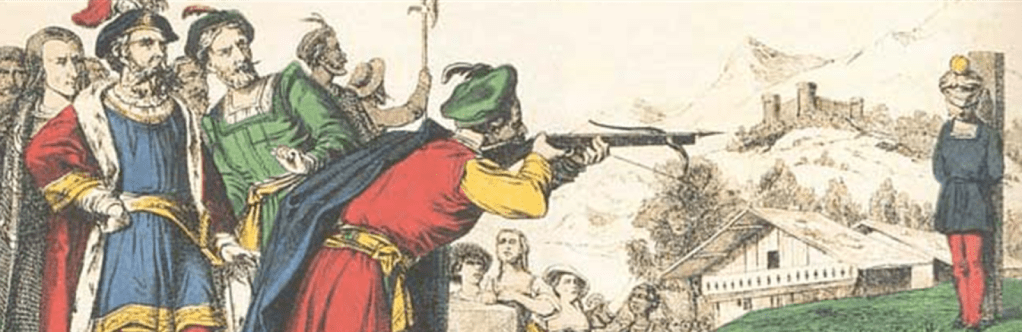
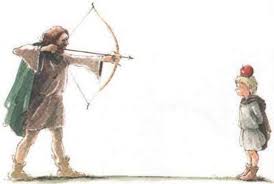
Legendary tales from Austria and Switzerland describe William Tell as a Swiss folk hero known for his defiance of Austrian rule and his exceptional skill as an archer. According to legend, on November 18, 1307, the Swiss patriot refused to pay homage to a Habsburg dignitary. An agent of the Austrian duke placed a Habsburg hat on a pole and ordered all passersby to remove their caps in respect. Tell refused and was punished by being forced to shoot an apple off his son’s head from 120 paces, or both he and his son would be executed. Tell placed two arrows in his jacket and successfully split the apple with a single shot. When asked why he needed two arrows, he replied that if he had killed his son, the second arrow would have been used on the Austrian official. Tell was then arrested and sent to a nearby castle.
At the last moment, Tell escaped captivity by leaping from the boat that was transporting him across Lake Lucerne. He landed among the rocks on the shore, a spot now marked by the Tellskapelle, a memorial chapel. A storm on the lake made it difficult for the officers to pursue him. According to the legend, this fortunate escape enabled Tell to later assassinate the Austrian officer, an act said to have inspired a rebellion that contributed to the formation of the Old Swiss Confederacy, the collection of states that eventually became modern Switzerland.
In 1829, composer Gioachino Rossini wrote an opera based on the William Tell saga, the last of his 39 operas. The fast section of its overture later became famous as the theme for The Lone Ranger television series in the 1950s. The William Tell Overture has also appeared in films such as The Princess Diaries and A Clockwork Orange. These cultural references helped popularize the legend and keep it alive in modern memory.
However, most historians believe William Tell was likely not a real person. There is no concrete evidence that he existed or that such an apple-shooting event ever occurred. More likely, the tale is a compilation of both real and imagined events, created as an inspirational story to stir patriotism among Swiss citizens. The first written account of Tell’s exploits appeared more than 250 years after the alleged incident and was later revised to better match historical records of Switzerland’s early independence, further suggesting that Tell’s life may be more myth than fact.
I.M.H.O.
So this story is most likely just mythical. However, it doesn’t make the legend any less compelling or powerful. William Tell is a symbol of freedom and independence, and represents the patriotism of the people and respect for nationalism, but also the ability to fight authority if it is unjust.
I’m S.A.Bear and I approve this message.

HOME


 Life is not a Spectator Sport
Leave a comment