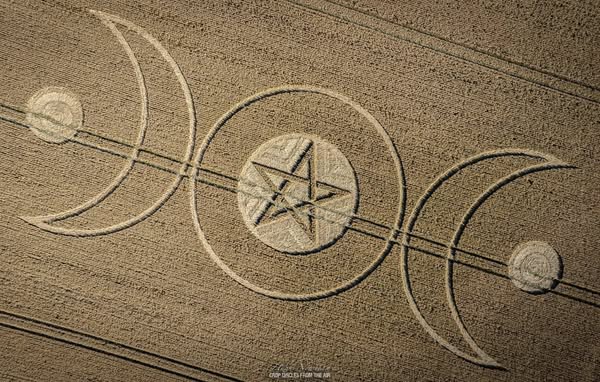
Ludwell, Wiltshire, England in the UK; 07/12.2025
Crop circles have been reported for centuries, but the modern era of widespread attention began in the 1970s. While many formations have since been attributed to human-made hoaxes, the mystery surrounding their origin—and the possibility of non-human involvement—continues to intrigue the public. Regardless of their source, crop circles have become a cultural phenomenon, attracting tourists and inspiring artistic and scientific interest alike.
Crop circles are large geometric patterns created by flattening crops, most famously in the fields of southern England, though they have appeared worldwide. Some researchers claim that certain unexplained formations display unusual plant anomalies. Others note that many circles appear near so-called “ley lines,” locations believed by some to be areas of heightened spiritual or historical significance linking ancient ceremonial sites.

In recent decades, particularly in the 21st century, crop circles appear to have increased in size and complexity. Many modern formations feature intricate geometric, mathematical, or astronomical designs. Seasonal patterns are also evident, since crop formations generally occur only when fields are in growth. Reports frequently emerge from the United Kingdom, especially the counties of Wiltshire and Hampshire, which are often associated with ley-line theories.
Early circles tended to be simple, and many clearly showed signs of human construction. By contrast, formations described as “unexplained” are often said to possess characteristics that enthusiasts argue are difficult to replicate. These commonly cited features include:
- Lack of board marks or imperfections: Hoaxers using boards and ropes may leave detectable impressions or uneven lines.
- Remote locations: Simpler hoaxes often appear near roads or populated areas, while more elaborate formations are sometimes found in less accessible fields.
- Unusual electromagnetic readings: Some investigators report abnormal instrument readings within certain formations.
- Bent stalks rather than broken ones: Plants are sometimes observed to be bent at the node and continue growing, leading to claims of heat or pressure effects rather than mechanical damage.
- Absence of obvious human traces: Enthusiasts often note a lack of footprints or tool marks, although this point is debated.
- Complex, intricate designs: Advanced geometric or fractal-like patterns can require significant planning and precision.
- Rapid or overnight appearance: Many formations are discovered suddenly, suggesting they were created in a short time span.
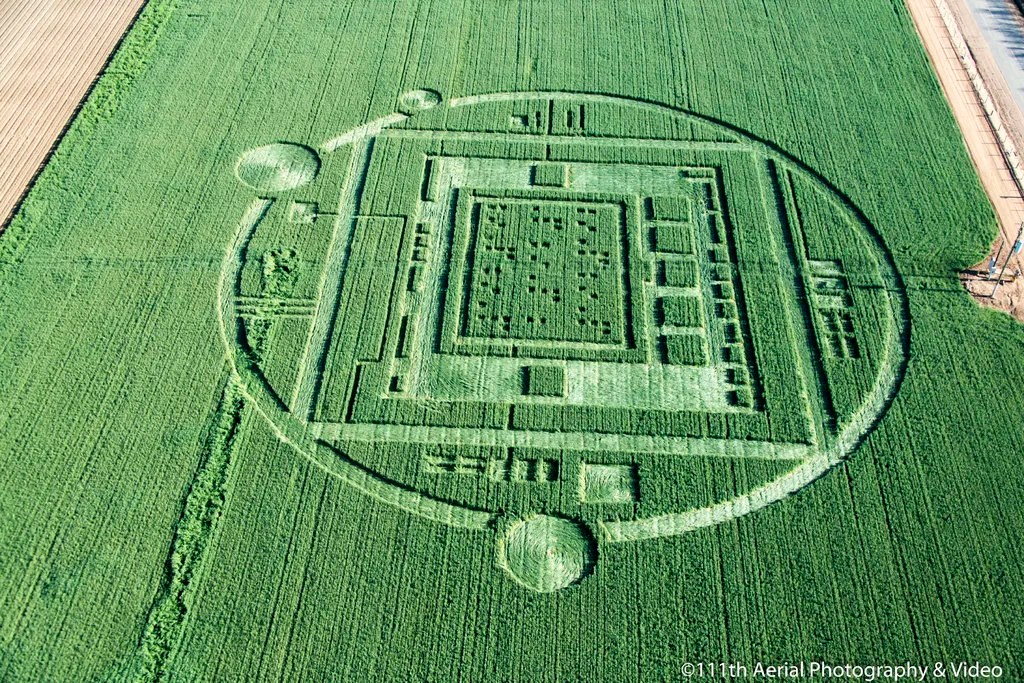
People who have visited formations sometimes report unusual sensations or electronic disturbances, such as drained batteries, though such claims remain anecdotal. Some circles reportedly reach diameters of nearly 300 feet, raising questions about the level of coordination required to produce them.
I have never personally seen a crop circle, but I am convinced that not every formation is man-made. At the same time, there is no definitive proof that extraterrestrials, time travelers, or unknown natural forces are responsible. Are crop circles a form of large-scale art, elaborate pranks, or vandalism? If they are not entirely human creations, what purpose would they serve—communication, warning, or simple expression?
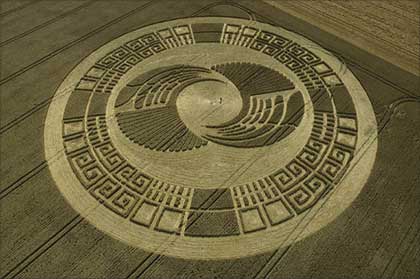
The most logical conclusion may be that many crop circles are the result of organized, heavily funded human effort, while others could stem from natural or misunderstood phenomena. It is also worth noting that similar patterns have been documented in sand, dirt, snow, and even flower beds. Not all serious researchers connect crop circles with alien theories; some view them as social art or environmental curiosities. Until more conclusive evidence emerges, the debate remains open—and that lingering uncertainty is part of what keeps the subject so fascinating.
For more information, click here
I’m S.A.Bear and I approve this message.


 Life is not a Spectator Sport
Leave a comment