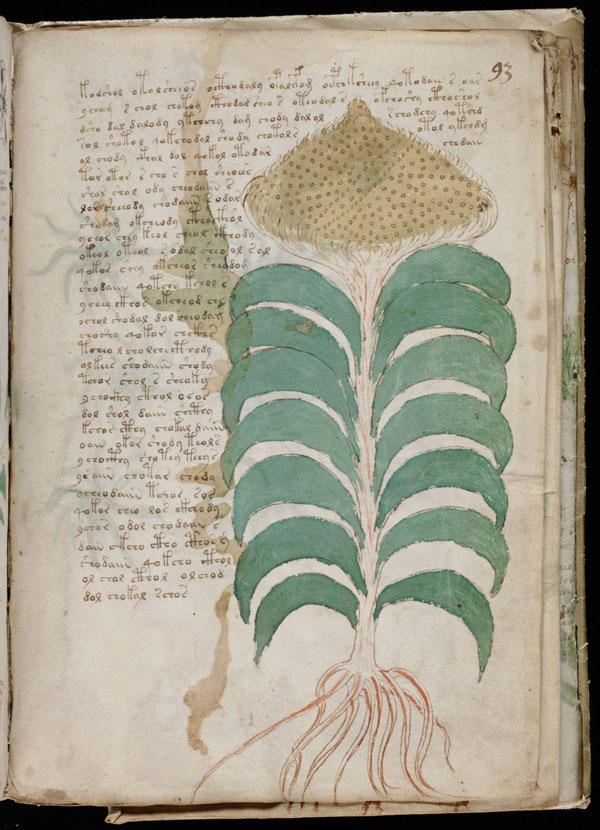
In 1921, rare book dealer Wilfred M. Voynich arrived in the United States carrying what he claimed would “startle the scientific world.” The object in question was not a painting, nor a lost Shakespearean play—but a book. A strange, handwritten manuscript filled with looping, unfamiliar symbols and illustrations that seemed to belong more to dreams than to reality.
More than a century later, that promise still lingers. The Voynich Manuscript has not just startled the world—it has defied it.
A Book From Nowhere
The Voynich Manuscript is a 15th-century vellum codex, roughly 240 pages long, now housed at the Beinecke Rare Book and Manuscript Library at Yale University. Radiocarbon dating places its creation in the early 1400s, and analysis of the ink confirms it was written during that same period—eliminating the possibility of a modern forgery scribbled onto ancient parchment.
Its journey through history is just as intriguing as its contents. The manuscript surfaced in the court of Holy Roman Emperor Rudolf II in the 17th century, where it was reportedly purchased for a significant sum—possibly under the belief that it held profound scientific or mystical knowledge. Centuries later, Voynich acquired it in 1912 from a Jesuit college near Rome, bringing it into the modern spotlight.
Tucked inside the manuscript was a letter suggesting it had been written by Roger Bacon, a 13th-century English friar known for his interest in science and cryptography. For a time, this theory captivated scholars. But modern testing has firmly placed the manuscript two centuries after Bacon’s lifetime, leaving its true author unknown.
The Language No One Can Read
What makes the Voynich Manuscript truly extraordinary is not just its age or its illustrations—it’s the text itself.
The manuscript is written in a completely unknown script. The characters are consistent and structured, suggesting a real language rather than random scribbles. Words repeat in patterns. Sentences seem to follow rules. Yet no one—not linguists, cryptographers, or artificial intelligence—has been able to decipher it.
Even some of the greatest codebreakers in history, including Alan Turing and specialists from both World Wars, have tried and failed to crack its code. The FBI has examined it. Modern computational analysis has dissected it. Still, the meaning remains elusive.
Today, it is often described as “the most mysterious book in the world” and “the greatest unsolved problem in cryptography.”
Strange Worlds on Every Page
If the text is baffling, the illustrations are equally unsettling—and fascinating.
The manuscript appears to be divided into thematic sections:
- Herbal: Pages filled with plants that resemble nothing found on Earth—hybrids of roots, stems, and flowers that defy classification.
- Astronomical: Circular diagrams, zodiac symbols, and star charts that hint at celestial knowledge.
- Biological: Perhaps the most bizarre—tiny, nude women bathing in interconnected pools and tubes, as if part of some surreal biological system.
- Pharmaceutical: Jars, roots, and fragments that resemble early medicinal diagrams.
Some pages even fold out into larger compositions—an unusual feature for a manuscript of its time—suggesting that whoever created it had both resources and intent.
Theories That Almost Explain It
Over the centuries, countless theories have attempted to explain the Voynich Manuscript. None have fully succeeded, but each offers a glimpse into the possibilities:
1. An Encrypted Scientific Text
Perhaps it is a medieval encyclopedia—an herbal or medical guide—written in code to protect valuable knowledge.
2. A Lost Language
Some researchers believe it may be written in a natural but extinct language or dialect, one that has simply vanished from history.
3. An Elaborate Hoax
Could it be a 15th-century con? A cleverly crafted book designed to appear mysterious and valuable, sold to a wealthy patron like Rudolf II?
4. Glossolalia (Trance Writing)
Another theory suggests the manuscript was written in a kind of invented language produced during a trance-like state—structured, but ultimately meaningless.
5. Something Stranger
Of course, more imaginative ideas persist: an alien diary, a message from another dimension, or knowledge far ahead of its time. These theories may stretch credibility, but they reflect the manuscript’s uncanny nature.
Why It Still Matters
In an age where algorithms decode genomes and machines translate languages instantly, the Voynich Manuscript stands as a humbling reminder: not everything yields its secrets.
Its mystery has sparked a rare kind of collaboration—linguists, historians, botanists, cryptographers, and computer scientists all working toward a single goal. It is not just a puzzle; it is a crossroads of disciplines.
And perhaps that is its true value.
Because whether the manuscript is eventually decoded or remains forever silent, it represents something deeply human: the urge to understand, to interpret, and to find meaning—even in the most impenetrable of texts.
The Last Page Remains Unturned
Today, anyone can view the full manuscript online through Yale’s digital archive. You can scroll through its pages, trace its strange symbols, and study its impossible plants.
But you will encounter the same truth that has confronted scholars for generations:
You can look at it.
You can study it.
You can even analyze it with the most advanced tools available.
But you cannot read it.
And that may be exactly why the Voynich Manuscript continues to captivate the world.
I’m SABear and I approve this message.


 Life is not a Spectator Sport
Leave a comment