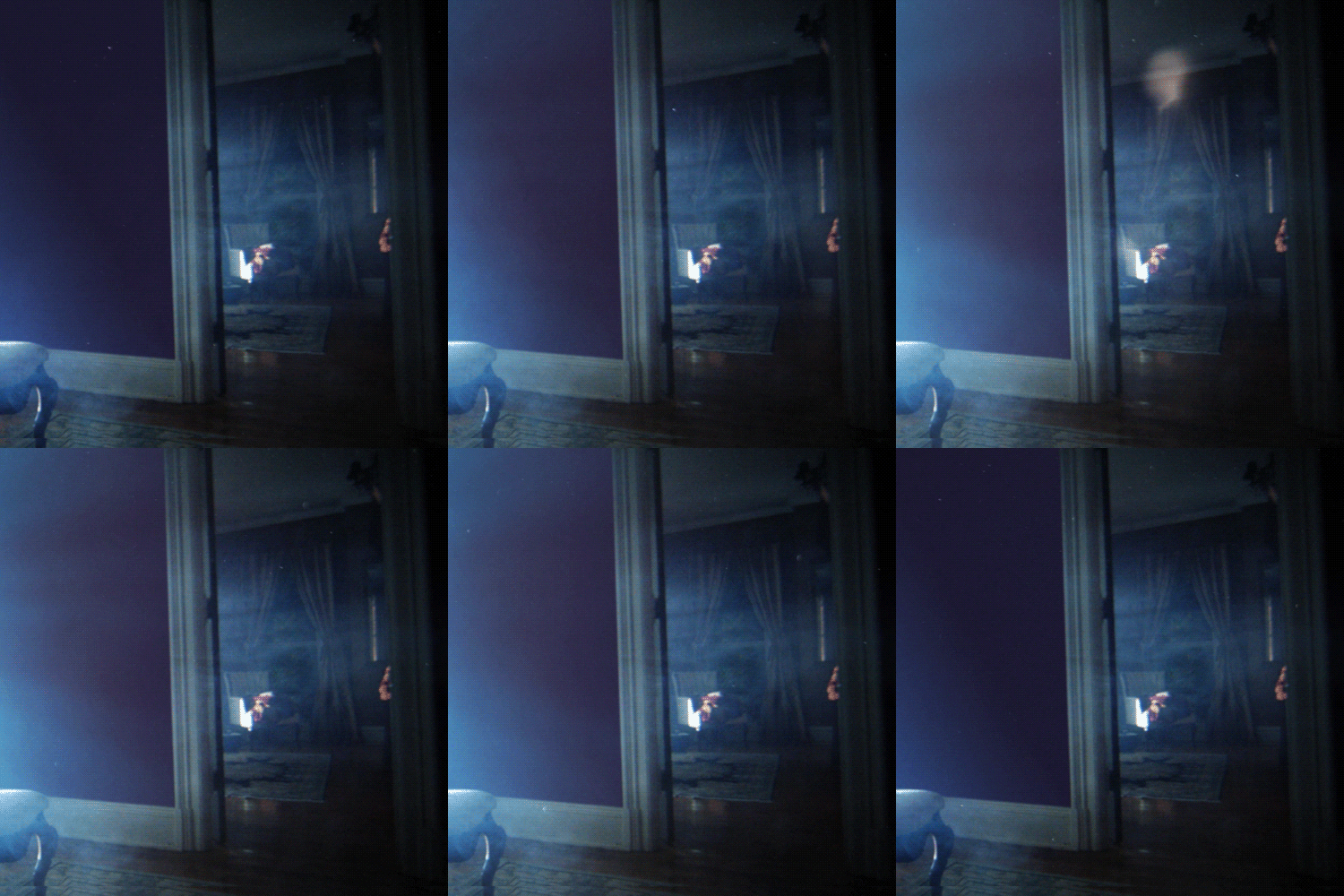
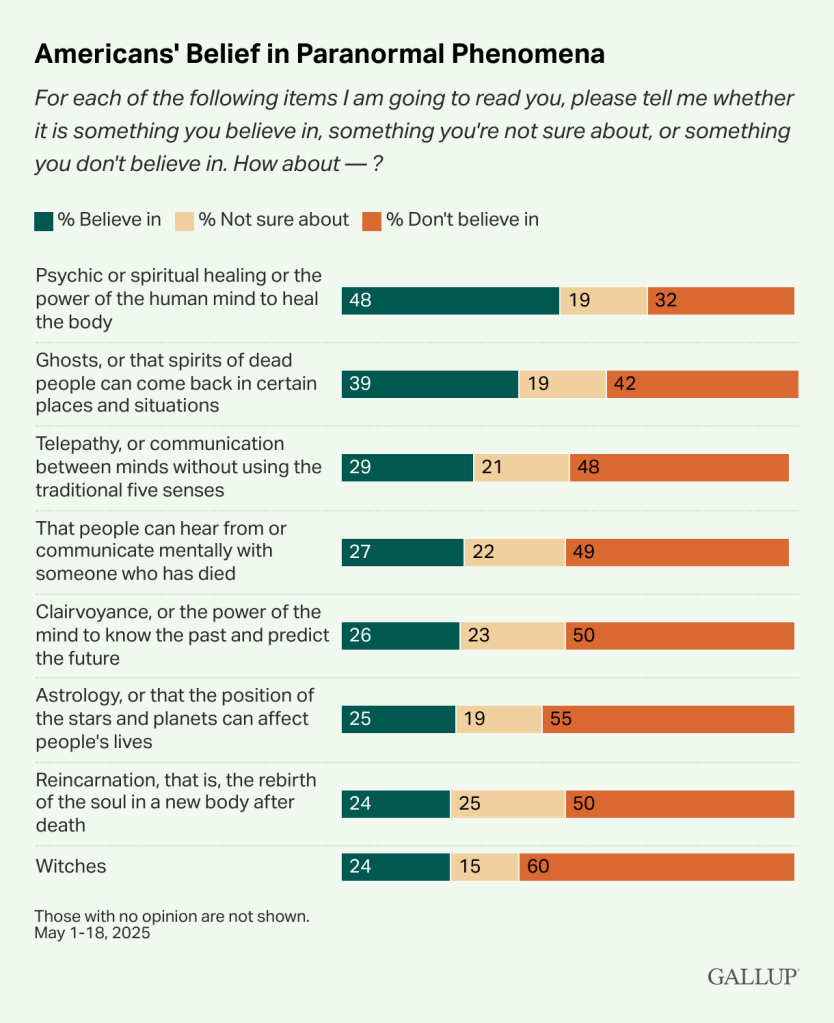
There’s something fascinating about the way Americans approach the paranormal right now. On the surface, we’re a skeptical bunch. A recent Gallup poll shows that no single supernatural belief wins over a majority. Only 48% of U.S. adults say they believe in psychic or spiritual healing, 39% believe in ghosts, and belief in other phenomena—like telepathy, astrology, or reincarnation—hovers between 24% and 29%. In fact, at least half of Americans actively reject ideas like clairvoyance, astrology, and witches.
And yet, that’s only half the story.
Scratch beneath the surface, and a different picture emerges—one that feels less like skepticism and more like curiosity held in tension. Barna’s research suggests that 82% of Americans are open to the possibility of a spiritual or supernatural dimension. Nearly three in four want to grow spiritually, and 79% believe in a higher power. That’s not indifference—that’s a quiet openness, even a longing.
So what’s going on here?
Part of the answer lies in how belief clusters. Gallup found that about a third of Americans (34%) are broadly open to the paranormal, often believing in multiple phenomena at once—an average of five. The remaining two-thirds are more skeptical, typically holding just one belief, if any. Interestingly, even skeptics tend to make an exception for psychic or spiritual healing, suggesting that the idea of unseen forces helping or restoring us has a unique appeal.
At the same time, engagement with paranormal practices is more casual than committed. About 30% of Americans consult astrology, tarot cards, or fortune tellers at least once a year—but most do so infrequently, and often just for fun. Only 7% say they rely on these practices for major life decisions. In other words, for many people, the paranormal is less a guiding force and more a curiosity—something to explore, not necessarily to trust.
Still, certain groups lean in more than others. Younger women, for example, show a higher belief in astrology, and more than half of Americans who identify as LGBT say they engage with practices like horoscopes or tarot at least yearly. On the flip side, groups as different as white evangelicals and atheists find common ground in their skepticism, with large majorities avoiding these practices altogether.
What’s especially intriguing is that this openness hasn’t translated into a surge in traditional religious engagement. Even as church attendance has declined, belief in the paranormal hasn’t dramatically increased either. Instead, Americans seem to be navigating spirituality in a more individualized way—drawing from a mix of curiosity, culture, and personal experience.
For those paying attention, this creates an unusual moment. Curiosity about the unseen isn’t disappearing—it’s diversifying. People are asking questions about meaning, mystery, and what lies beyond the visible world, but they’re not always turning to traditional institutions for answers.
That presents both a challenge and an opportunity. Conversations about the paranormal don’t have to be dismissed or feared; they can serve as entry points into deeper discussions about belief, purpose, and truth. When approached with thoughtfulness and respect, these topics reveal something important: people aren’t just chasing strange phenomena—they’re searching for meaning.
And that search, more than any statistic, is what makes this moment so compelling.
I’m SABear and I approve this message.


 Life is not a Spectator Sport
Leave a comment