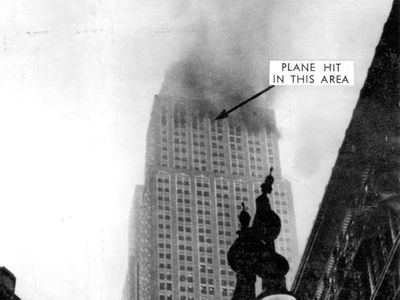
On a foggy morning in New York City—July 28, 1945—the Empire State Building became the site of one of the strangest survival stories you’ve probably never fully heard. It begins like a tragedy, the kind you’d expect in wartime America, and somehow turns into something that feels almost… impossible.
A B-25 Mitchell bomber, lost in thick fog, was trying to land. LaGuardia was out of the question, so the pilot redirected toward Newark. That decision sent the aircraft directly over Manhattan, where visibility dropped to near zero. At some point—likely disoriented—the pilot veered off course. The plane skimmed dangerously close to the Chrysler Building before slamming into the north side of the Empire State Building between the 78th and 80th floors at 9:40 a.m.
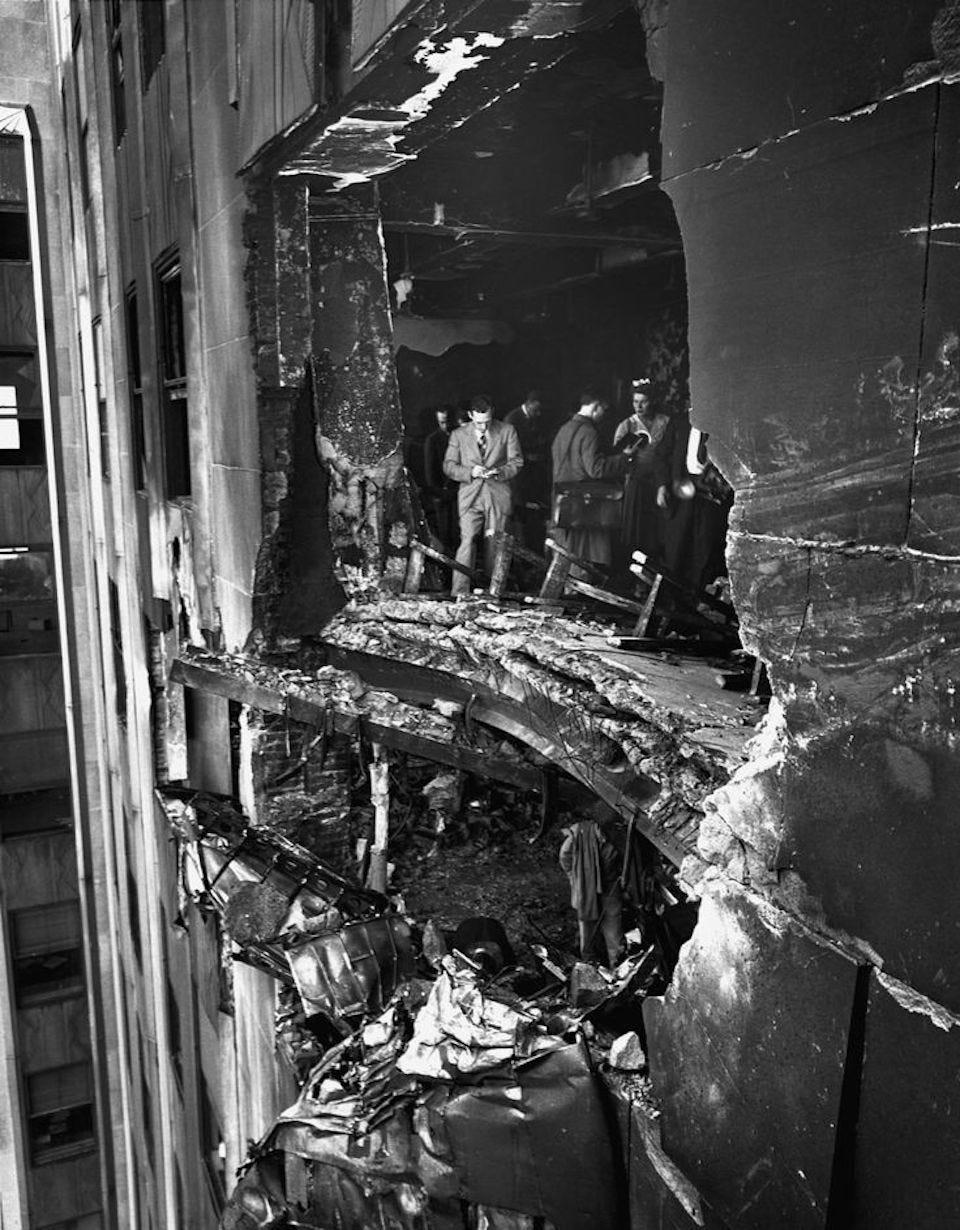
The crash killed 14 people—three on the plane and 11 inside the building. Fire tore through the upper floors, becoming the highest structural fire ever successfully contained at the time, extinguished in just 40 minutes. Debris rained down across the city. One engine blasted completely through the building and landed on a nearby block. Another disappeared into an elevator shaft.
And that’s where this story takes a turn.
Betty Lou Oliver was just 20 years old, working as an elevator operator. She was in her car on the 80th floor when the plane hit. The impact threw her from the elevator, leaving her badly burned as flames spread through the floor. Somehow, she survived that initial blast—a miracle in itself.
Rescuers found her and, acting quickly, placed her into another elevator to send her down to safety. It seemed like the right move in a moment where every second mattered.
But no one realized the crash had already damaged the elevator system.
As the car began its descent, the cables—compromised by the impact—snapped.
What happened next sounds less like history and more like something pulled from a nightmare. The elevator plunged. Seventy-five stories. A straight drop from the upper floors of one of the tallest buildings in the world.
And Betty Lou Oliver was conscious the entire time.
She later described the sensation in a way that’s both simple and eerie: it felt like the elevator was rushing away from her, as if gravity itself had loosened its grip. She held onto the sides to keep from floating. Imagine that for a second—the world falling out from under you, your body unsure whether it belongs to the fall or something else entirely.
By all logic, that should have been the end of her story.
But it wasn’t.
Somehow, Oliver survived the fall. To this day, her plunge is often cited as the longest elevator fall survived in history. So how did she live?

There are a few explanations—none of them comforting, all of them astonishing. As the elevator hurtled downward, air pressure in the narrow shaft may have built up beneath it, slowing its descent slightly, like an invisible cushion. When it hit bottom, it crashed into an oil buffer system designed to absorb impact—though the force was so extreme it drove the buffer through the floor.
There’s also evidence that the snapped cables piled up beneath the car, creating an additional layer of resistance. And Oliver herself, gripping the sides and likely positioned low in the car, may have distributed the force of the impact just enough to keep it from being instantly fatal.
Still, survival under those conditions borders on unbelievable.
She didn’t walk away unharmed—far from it. Oliver suffered severe injuries, including fractures to her pelvis, back, and neck. But she lived. She recovered. She went on.
And that’s the part that lingers.
Because stories like this sit in a strange space between fact and feeling. Everything about the event is documented, explained, filed neatly into history. And yet, there’s something about it that resists easy closure. Two near-death moments, back to back. A sequence of failures that should have guaranteed an outcome—and didn’t.
You can call it physics. You can call it luck. You can call it a perfect storm of variables aligning at just the right moment.
But it’s hard not to wonder if there’s something else at play—something we don’t quite have language for.
Nearly 80 years later, Betty Lou Oliver’s story still pulls people in, not just because she survived, but because of how she survived. It reminds us that even in a world we think we understand, there are moments that slip through the cracks of explanation.
And sometimes, those are the stories we can’t stop thinking about.
I’m SABear and I approve this message.

Leave a comment

 Life is not a Spectator Sport