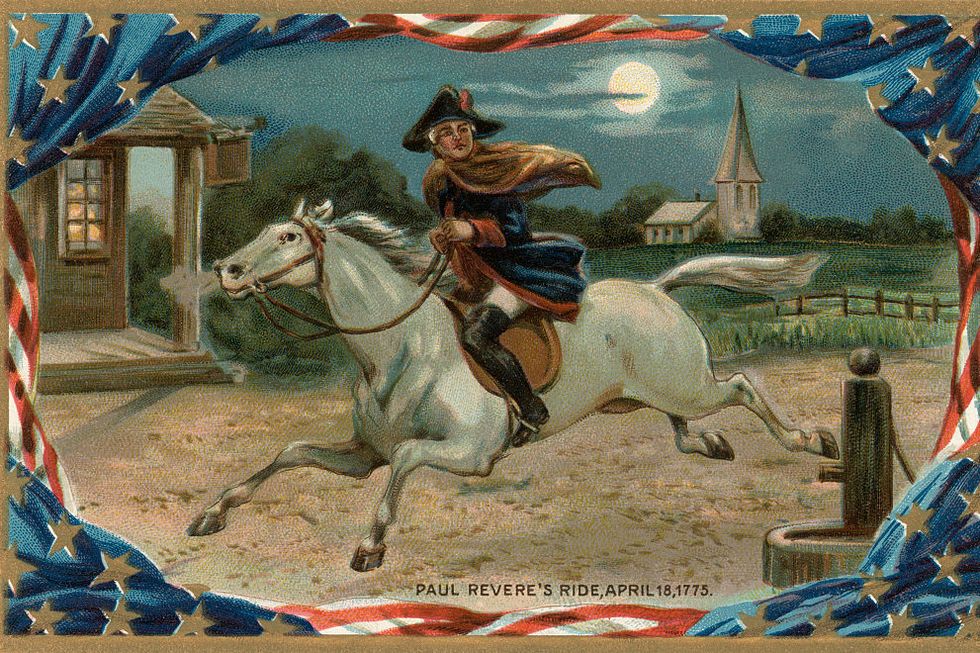
Listen, my children, and you shall hear
Of the midnight ride of Paul Revere,
On the eighteenth of April, in Seventy-Five:
Hardly a man is now alive
Who remembers that famous day and year…..
…One if by land, and two if by sea;
And I on the opposite shore will be,
Ready to ride and spread the alarm
Through every Middlesex village and farm,
For the country-folk to be up and to arm.
H.W. Longfellow

When Paul Revere was a boy, he was taught the craft of being a silversmith by his father Apollos Rivoire (later changed to Revere). Paul Revere soon became one of America’s greatest artists in silver. He also made copper plates, the most famous of which was his depiction of the Boston Massacre. In 1773, he joined 50 other patriots in an act of rebellion known today as the Boston Tea Party.
Revere served for years as the principal rider for Boston’s Committee of Safety, making journeys to New York and Philadelphia in its service. The three main goals of the committees were to establish a system of communication with other assemblies in the other colonies, educate the townspeople on their political rights, and obviously, rally support to the cause of American independence against British rule.
As part of Boston’s Committee of Safety he was in one of America’s earliest intelligence organizations, who referred to themselves as “the mechanics.” Just 11 days before his midnight ride, the mechanics traveled to Concord to warn the Massachusetts Provincial Congress of possible troop movements from the British army, then referred to as the Regulars.

On April 16, 1775, in what Longfellow called “the midnight ride of Paul Revere,” Revere rode to nearby Concord to urge the patriots to move their military stores, which were endangered by pending British troop movements. At that time, Revere arranged to have the famous lantern signal arranged in Boston’s Old North Church steeple. Two nights later, he set out on what would be the more patriotic journey. He primarily was seeking to warn John Hancock and Samuel Adams that troops were being dispatched to arrest them, which turned out to be faulty intelligence. Another messenger, William Dawes, had already been sent out on a different route than Revere’s to Lexington. It was decided to send two riders in case one was intercepted by British forces. In fact, a third rider was recruited along the way, Dr. Samuel Prescott.
After carrying their message along their routes, they decided to continue on to Concord, Massachusetts, to verify that the military stores were properly dispersed and hidden away. On the way to Concord, they were ambushed by British troops. Revere was captured, questioned and his horse was confiscated. Paul Revere returned to Lexington on foot.
Paul Revere was among scores of true patriots in the most important days of our Republic. If social media were active then, he would’ve been a YouTube action hero. America was forged on the bravery of literally hundreds rebels, most of which will never be remembered. Longfellow penned his famous poem some 80 years after the American Revolution using liberal poetic license. As has been written, Longfellow could have just as easily written “Listen, my children, and give some applause for the midnight ride of William Dawes,” and it would have been just as accurate. Whether or not Paul Revere actually rode through the countryside screaming “The British are coming” is irrelevant and mostly symbolic. To see an account of Revere’s own account click here. Every nation has their own tales of heroism. They add to national pride and identity and should be celebrated.
I’m S.A.Bear and I approve this message.

 Life is not a Spectator Sport
Leave a comment