In the context of college athletics, “NIL” stands for Name, Image, and Likeness, referring to the legal rights athletes have to control and profit from their personal brand.
That connotation of “NIL” became insignificant on July 1, 2021. That is when the National Collegiate Athletic Association (NCAA) officially allowed student-athletes to profit from their name, image, and likeness.
Before this date there were countless rumors that athletes on most major college football and basketball squads received favors in return for signing with a big-time college. These favors could have ranged from cash or automobiles to lucrative jobs for their parents.
In the early 2000’s, Reggie Bush was investigated for recruiting violations. It was found that he did accept cash, travel expenses and a house during his time at USC. The NCAA also found that Bush’s parents were living rent-free for over a year and were provided $10,000.
When Cam Newton was a seventeen year old senior, he was heavily recruited by Mississippi State, Florida, Maryland, Oklahoma and Georgia. After bouncing from the University of Florida and Blinn College, it was alleged that he (or his father) solicited as much as $180,000 to bring Cam to Mississippi State. When Newton finally joined Auburn University, it was generally believed that a substantial monetary bonus was given to the athlete.
Over the years, numerous players have been accused of taking money from university sport boosters, sports agents and even directly from the college officials themselves. The NCAA struggled to determine a binding definition of what stipulates an amateur athlete. Some college athletes were allowed to be paid in one sport as a professional, while being able to compete as an amateur in NCAA competition in another sport. In 1912, Native American Jim Thorpe became the sole winner of the decathlon and pentathlon of the 1912 Olympic games in Stockholm, Sweden. The International Olympic Committee (IOC) stripped him of his medals less than a year later. He was found to have been paid to play baseball in the Eastern Carolina League for Rocky Mount, North Carolina, in 1909 and 1910.
A landmark legal case was initiated in 2014. A suit was brought against Northwestern University by the College Athletes Players Association (CAPA). Essentially, CAPA claimed that those football players who receive grant-in-aid scholarships from Northwestern were “employees” under the National Labor Relations Act and as such were legally able to be represented by CAPA for the purpose of receiving collectively bargained wages.
The National Labor Relations Board, Region 13 in Chicago ruled in favor of CAPA, thus entitling them to unionize and partake in collective-bargaining for employment rights. The ruling also delineated strict guidelines on what all athletes may and may not do in acquiring additional individual profit as well as guidelines on their academic lives. Players were prohibited from profiting off their image or reputation, including the selling of merchandise and autographs. They were required to sign a release allowing the university and the Big Ten conference to use their name, image and likeness for whatever purpose they desired. Regardless of these imposed constraints, the ruling was a huge hurdle to allow modern student-athletes to gain the benefits that they today enjoy.
Student-athlete is a term that has been kicked around amateur sports for a few decades. It can be traced back to 1957 when the widow of Ray Dennison, who died from a head injury in 1955 while playing in Colorado for the Fort Lewis A&M Aggies, filed for workmen’s compensation death benefits. The Colorado Supreme Court ruled that the widow was not eligible to receive benefits because the college was “not in the football business.” These are young men and women that are recruited to the college not to meet academic standards, but to benefit the college by performing at a high athletic level.
In 2009, Ed O’Bannon, a former UCLA basketball player, legally challenged the NCAA and the Collegiate Licensing Company. He filed a class-action antitrust claiming student athletes should hold their own rights to their own name, image and likeness. Eventually, the United States Supreme Court held that the NCAA had violated antitrust regulations by limiting player rewards to education-related benefits. Thereafter, the NCAA launched new rules allowing schools to set their own NIL policies. Since 2022, 32 states have passed NIL laws, all of which are mostly modeled after the California “Fair Pay to Play Act”. This law makes it illegal for schools to deny student-athletes the right to earn a profit from their NIL, and permits student-athletes to hire agents for securing and negotiating NIL deals.
The NCAA continues to use vague guidelines and loose enforcement of NIL licensing opportunities for athletes. Some states have laws in place that say athletic departments and their employees may not “cause compensation to be directed” to athletes, but the specifics of what is and is not allowed remain murky.
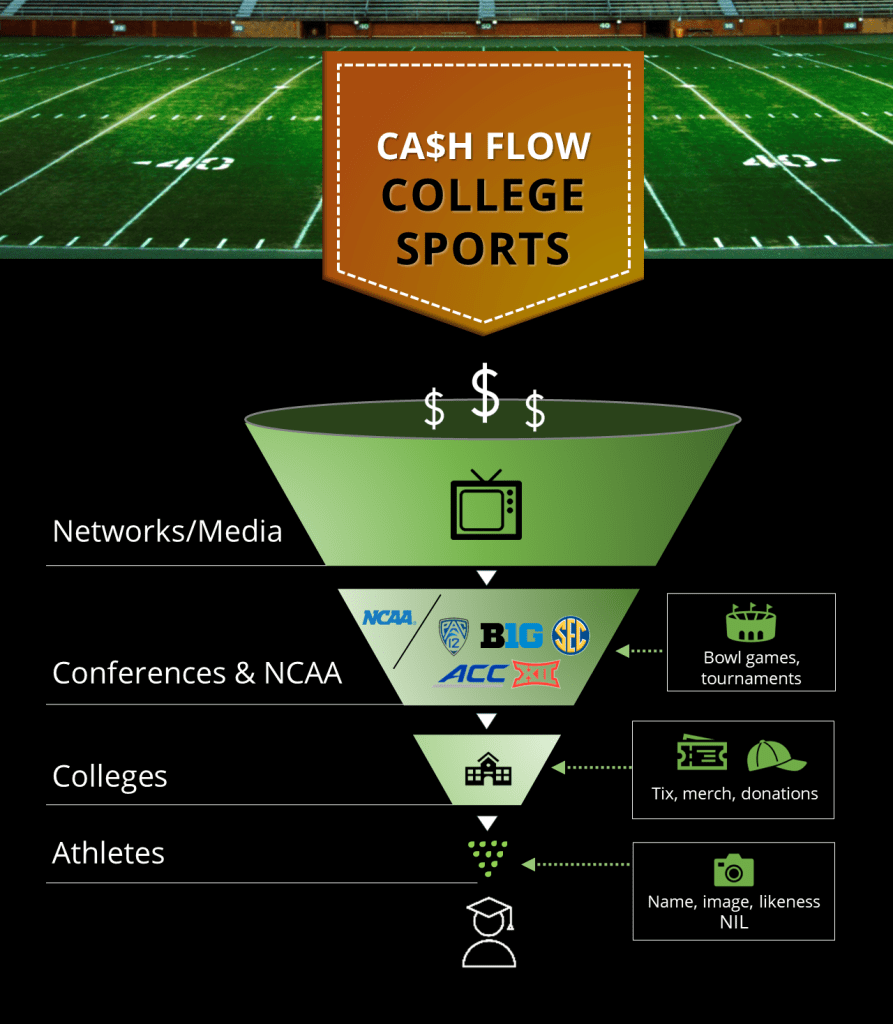
One key thing to remember is that NIL money doesn’t come from the schools themselves. Colleges aren’t paying athletes directly; instead, NIL deals are between the athletes and outside
or sponsors. Funding sources come from outside the influence of the university, from various businesses, sponsors or even sports agents. The NIL phenomena is still relatively new and each state handles it differently. As a result, colleges in one state can have more profitable opportunities than in the state the athlete lives in or at the college/university he/she has been attending.
Since the 2022 “Pay to Play” ruling student-athletes have been taking advantage of NIL deals. Some extreme examples show Shadeur Sanders (Colorado QB) receiving an estimated $12 million deal, Livvy Dunne (LSU gymnast) earning what is reported to be a nearly $4 million deal and Caitlin Clark (Iowa basketball) signing endorsement deals with Nike, State Farm and Gatorade. NIL deals have now become a staple part of the recruiting of high school players into college. Where before parents wanted assurances from coaches that their son or daughter will be treated fairly and given help to complete college with a degree. Now before long into the initial interview process, the parents want to know how much their athlete is receiving.
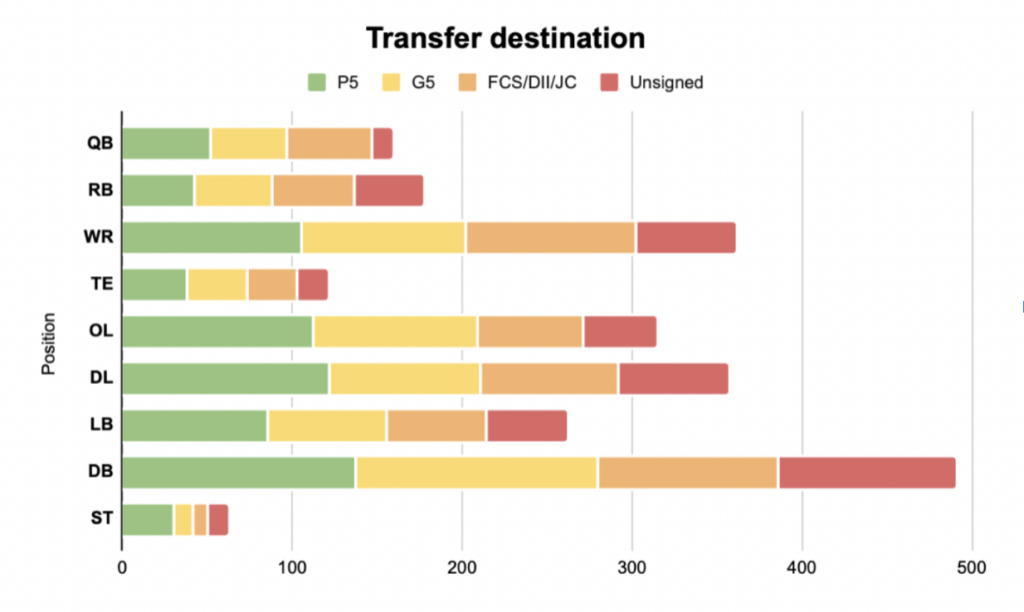
The collegiate transfer portal, which allows athletes to move from one college to another, has been very active in recent years. Some reasons include the desire to attend school closer to their hometown, securing a spot on a sports team that will allow a better opportunity to play regularly, or a chance to join former coaches or friends at a different school. However, the chance to land a lucrative NIL deal is also a major factor. The process involves a student declining all existing benefits from school he or she is currently attending and declaring availability through the collegiate online transfer portal. In 2023 alone, more than 31,000 student-athletes took the gamble of entering the portal. While approximately 45% were successful in moving to another school, over 17,000 were left with no option but to likely never compete again in the NCAA. Additionally, these students are left on their own to try and secure admission to another institution to complete coursework for a degree. Even when transfers are successfully completed, 60-70% of academic credits are often lost in transfers.
Eccker Sports
The effects of NILs and transfers are often felt in the locker rooms. Resentment and jealousies over more robust NIL deals and decreases in playing time can disturb the chemistry of big-time university teams. Demands from portal transferees have reached $500K and more. Some schools formally allocate $20 million and more for athlete compensation.
IMHO
While it’s clear neither college administrators nor student-athletes would want to go back to the old system, some modifications to the current system are required. Some measures may include better academic support systems, more structure in the transfer window, and clearer or more standard NIL regulations. The NIL evolution and transfer portal have created advantages and challenges for colleges and student-athletes. However, the NIL interactions have been likened to the Wild Wild West. The swipe right culture of online selection/rejection of student athletes by college administrators has some comparing the portal to an online dating service.
Measures to arrive at a solution can stretch into the private sector. One private equity solution sees Redbird Capital and Weatherford Capital joining to form Collegiate Athletic Solutions pitching a deal to rescue athletic departments. The plans they
bring serious financial capital and new income streams that lead to genuine partnership obligations. These two institutions have joint established ties with institutions like the Boston Red Sox, AC Milan, and Formula One team, Alpine. The inclusion of private equity funds brings its own problems.
We may look at those issues…..incoming issues.
I am SABear, and I approve this post.

 Life is not a Spectator Sport