
“Half a truth is often a great lie,” Benjamin Franklin

Benjamin Franklin was considered to be the most ‘common-man’ among the aristocratic leaders of the Revolution. His worth to a budding nation was as an inventor and in his ability to communicate orally and through the written word. He helped to draft and compose the Declaration of Independence as well as the U.S Constitution. Our founding fathers were the earliest of our American heroes. We like to tell stories of them and share the tales from generation to generation. There is plenty of historical record around most of our revolutionary leaders, but most of the repeated stories of these statesmen is anecdotal. These heroes were often misquoted or had quotes inaccurately attributed to them. Franklin wrote about truth during the quarter century he published Poor Richard’s Almanack. He was one of the most quoted of all historical figures.
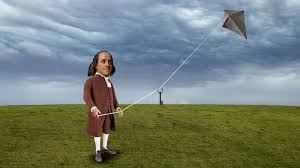
In the early 1750’s he turned to the study of electricity. His observations, including his kite experiment which verified the nature of electricity and lightning brought Franklin international fame. Franklin had originally been planning to perform the experiment from the spire of a church that was being erected. He soon changed his plans to use a kite to act as a conduit for carrying the charge of a lightning strike. He wanted to demonstrate the electrical nature of lightning, and to do so, he needed a thunderstorm. He also needed a kite made with a large silk handkerchief, a hemp string, and a silk string. Despite a common misconception, Benjamin Franklin did not discover electricity during this experiment. Electrical forces had been recognized for hundreds of years, and scientists had worked extensively with static electricity. Franklin’s experiment demonstrated the connection between lightning and electricity.Contrary to popular belief Franklin’s kite was not struck by lightning. If it had been, he probably would have been electrocuted, experts say. Instead, the kite picked up the ambient electrical charge from the storm. Franklin tied a metal house key to a wet hemp string suspended from the silk kite string. At some point, Franklin noticed loose threads of the hemp string standing erect. Franklin moved his finger close to the key, and as the negative charges in the metal key were attracted to the positive charges in his hand, he felt a spark.
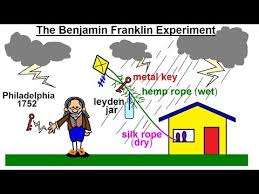
British scientist Joseph Priestley documented the experiment in closing that by using a Leyden jar, Franklin “collected electric fire very copiously,” That “electric fire”—or electricity—could then be discharged at a later time. Franklin wasn’t the first to demonstrate the electrical nature of lightning. A month earlier it was successfully done by Thomas-François Dalibard in northern France. After his successful demonstration, Franklin continued his work with electricity, going on to perfect his lightning rod invention. In 1753, he received the prestigious Copley Medal from the Royal Society, in recognition of his “curious experiments and observations on electricity.”
What is true and what isn’t about Franklin?
Franklin did invent the Franklin stove, an iron furnace that used less wood than traditional furnaces. Was Franklin a womanizer? Franklin was known for his flirtatious nature and fathered an illegitimate child. However, there’s no definitive evidence of marital infidelity during his marriage.

Did he invent bifocals? He did invent bifocals, he also invented a pair of swim fins for his hands and was inducted into the International Swimming Hall of Fame.

Franklin did not want the turkey to be the national symbol. He preferred the eagle, but he did experiment with turkeys and electricity, noting their tender flesh when killed in this manner.
Franklin did not invent the odometer, though he did use and improve upon existing devices for measuring distance.
Franklin was instrumental in overseeing the installation of streetlights in Philadelphia and designed a better version, but other cities had implemented streetlights earlier.
Franklin also was a key figure in the colonial postal system. In 1737, the British appointed him postmaster of Philadelphia, and he went on to become, in 1753, joint postmaster general for all the American colonies. Benjamin Franklin is the only Founding Father to have signed all four of the key documents establishing the U.S.: the Declaration of Independence (1776), the Treaty of Alliance with France (1778), the Treaty of Paris establishing peace with Great Britain (1783) and the U.S. Constitution (1787).
I.M.H.O.
Franklin died at age 84, on April 17, 1790, in Philadelphia. Following a funeral that was attended by an estimated 20,000 people, he was buried in Philadelphia’s Christ Church cemetery. In his will, he left money to Boston and Philadelphia, which was later used to establish a trade school and a science museum and fund scholarships and other community projects. More than 200 years after his death, Franklin remains one of the most celebrated figures in U.S. history. His image appears on the $100 bill, and towns, schools and businesses across America are named for him. You have to have lived a pretty good life to deserve all of that.
I’m SABear and I approve this message.

 Life is not a Spectator Sport
Leave a comment