
In the fairly short history of air travel, the survival of Vesna Vulović, a Serbian flight attendant, after falling from a height of 33,000 feet will be difficult to surpass as the most unbelieveable. On January 26, 1972, JAT Yugoslav Airlines Flight 367 left from Stockholm en route to Belgrade, making a routine stop in Copenhagen, Denmark. Cruising at an altitude of 33,000 feet over Czechoslovakia, the DC-9 was carrying 28 passengers and 6 crew members, including Vesna Vulović, who was a 22-year-old flight attendant at the time. She is working in this flight because the person organising the rotas mixed her up with another colleague also called Vesna. But Vulović was happy about it all since she had always wanted to visit Denmark’s capital and sleep in the Sheraton.
Vesna recollected, “The last thing I remember is boarding the plane by the rear door and seeing a few women cleaning the plane.” She has no recollection of the flight itself. The most common explanation for what happened is that the plane was destroyed by an explosion caused by a bomb which was placed there by Croatian terrorists. She recalled that one particularly grumpy passenger had checked his bag for the connecting flight, but didn’t board. She believes that the bomb was placed inside his bag. All of the 28 people on the flight died except for Vulović, and since she has no memory of the flight or the landing, no one is quite sure how she survived. During the investigation, authorities discovered that Vesna had become trapped in a food cart in the tail section of the aircraft, which landed on snow and thereby cushioned her fall. Doctors believed her low blood pressure caused her to black out and avoid succumbing to a heart attack during the fall and crash.
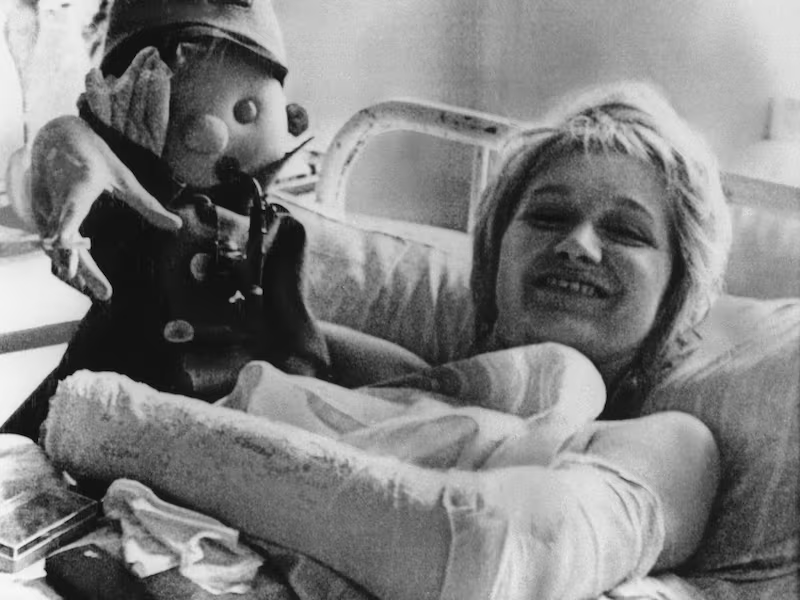
Vesna Vulović was near the rear of the aircraft when the plane exploded at over 30,000 feet. She was pinned to the back of the plane and fell to earth in the tail of the aircraft. The fall was broken by trees and landed in thick snow. Her screams led to her rescue, though she later fell into a coma for some time. She had sustained severe injuries, including:
A fractured skull
Two broken legs
A crushed vertebra
A ruptured liver
Several broken ribs
The young flight attendant was rushed to the hospital, where she underwent multiple surgeries to repair the damage caused by the crash. Despite the severity of her injuries, she was miraculously alive. The tail section, which detached from the rest of the fuselage after the bomb explosion, likely provided some degree of structural protection during the fall.
Unlike the rest of the plane, which disintegrated mid-air, the tail section was relatively intact and may have acted like a parachute of sorts, slowing the descent. Moreover, the tail section was likely to have been tumbling during its descent, possibly reducing the severity of the impact when it finally hit the ground. In Vulović’s case, the combination of a relatively intact tail section, the terrain below, and perhaps a heavy dose of luck all aligned to make the impossible possible.
 Life is not a Spectator Sport
Leave a comment