Long before the current string of disappearances, there has been a quiet, controversial history of scientists, researchers, and government officials connected—sometimes loosely, sometimes directly—to UFO-related topics who died or vanished under circumstances many have found difficult to explain.
One of the most frequently cited cases is that of James E. McDonald, a respected atmospheric physicist who became one of the most prominent scientific voices advocating for serious study of UFOs in the 1960s. His death in 1971 was officially ruled a suicide, yet questions have lingered due to his professional pressures and outspoken criticism of government handling of UFO data.
Similarly, Morris K. Jessup, known for his work on unconventional propulsion theories and UFO phenomena, died in 1959 under circumstances also ruled a suicide. However, his involvement in mysterious correspondence—often referred to as the “Allende letters”—has fueled decades of speculation about whether he had stumbled onto classified information.
Even among government insiders, unease has persisted. Forrestal James (more commonly known as James Forrestal), the first U.S. Secretary of Defense, died in 1949 after falling from a hospital window. While officially deemed a suicide, conspiracy theories have long suggested he may have known too much about early military encounters with unexplained aerial phenomena.
Fast forward to more recent decades, and the pattern—at least in the eyes of some observers—doesn’t entirely fade. Philip Schneider, who claimed involvement in deep underground military projects and alleged encounters with non-human entities, died in 1996. His death was ruled a suicide, but supporters have questioned that conclusion due to inconsistencies surrounding the scene.
Then there are cases that remain more ambiguous than controversial—figures like Mark McCandlish, who spoke publicly about alleged advanced propulsion systems and “alien reproduction vehicles.” His death in 2021 was also ruled a suicide, yet it reignited discussion about the risks faced by those who publicly challenge official narratives.
To be clear, in many of these cases, official investigations have found no evidence of foul play. Mental health struggles, professional pressures, and personal circumstances often provide more grounded explanations. Still, the recurrence of high-profile individuals—each connected in some way to aerospace, defense, or UFO research—has created a long-standing undercurrent of suspicion that refuses to fully disappear.
It is against this historical backdrop that today’s developments take on a more ominous tone.
Something unsettling is unfolding—quietly, almost beneath the surface—but loud enough for those paying attention to feel it. Over the past year, reports have emerged of now ten scientists and high-level professionals—some with ties to defense, aerospace, and advanced research—who are either dead or missing under strange circumstances. At first glance, these cases appear isolated. But the deeper you look, the harder it becomes to ignore the possibility that something more coordinated—or at least more consequential—is at play.
Let’s start with what we know.
Authorities in New Mexico, including the Bernalillo County Sheriff’s Department, have confirmed they are at least exploring whether there is any connection between several of these disappearances. One of the most notable figures is retired Air Force General William “Neil” McCasland. A man deeply embedded in military research and development circles, McCasland’s background alone raises questions—not answers. His disappearance, still unresolved, is now being examined alongside others with overlapping professional ties.
One of those ties leads to Monica Reza, described as a “rocket scientist,” who reportedly shared a close professional connection with McCasland. The fact that both individuals vanished within an eight-month window is difficult to dismiss as coincidence. These are not random citizens; they are highly specialized professionals working in fields often adjacent to classified research, advanced propulsion systems, and, potentially, unidentified aerial phenomena.
Then comes the most recent and perhaps most troubling addition to the list: Steven Garcia.
Garcia, a 48-year-old government contractor, disappeared on August 28, 2025, after walking out of his Albuquerque home in broad daylight. According to reports, he was last seen wearing a camouflage shirt and carrying a handgun—details that suggest he may have felt a need for protection. He never returned.
But it’s Garcia’s job that raises eyebrows.
He reportedly worked at the Kansas City National Security Campus, a critical site responsible for producing over 80% of the non-nuclear components used in U.S. nuclear weapons systems. This isn’t just any facility—it’s a cornerstone of national defense infrastructure. Garcia’s role as a property custodian may sound administrative, but sources indicate it involved oversight of tens to hundreds of millions of dollars in equipment, including classified assets. With top-level security clearance and broad access across the facility, Garcia was in a position to know—quite literally—where everything was.
That kind of access comes with both privilege and risk.
Where UFOs Enter the Picture
Now, here’s where things become more speculative—but no less compelling.
In recent years, public interest in UFOs—more formally referred to as UAPs (Unidentified Aerial Phenomena)—has surged. This is due in part to official disclosures from agencies like the Pentagon, as well as high-profile testimonies from whistleblowers. The conversation has shifted from fringe theory to legitimate inquiry, with government acknowledgment that some aerial encounters remain unexplained.
Within that context, individuals like McCasland, Reza, and Garcia occupy a unique intersection: advanced science, military infrastructure, and potential exposure to classified aerospace technologies.
Is it possible that some of these individuals were involved—directly or indirectly—in programs related to reverse engineering, propulsion research, or materials analysis tied to UAPs?
There is no publicly verified evidence confirming that. But the overlap between their professional environments and the types of research long rumored to exist is enough to keep the question alive.
Coincidence, Conspiracy, or Something In Between?
History offers examples that fuel both skepticism and suspicion. During the Cold War, scientists involved in sensitive research were often targets of espionage, surveillance, and, in rare cases, elimination. The stakes were existential. Today, the stakes may be just as high—only the battlefield has shifted.
Could foreign intelligence agencies be targeting individuals with access to sensitive defense technologies? That’s one plausible explanation.
Could internal security breaches, whistleblowing fears, or undisclosed programs be contributing factors? Also possible.
Or are we witnessing a string of tragic but unrelated events being woven together by pattern-seeking minds in an age of information overload?
That’s the question.
The Danger of Silence
What makes this situation particularly troubling isn’t just the disappearances—it’s the lack of clarity. When highly credentialed individuals with access to sensitive information vanish without explanation, it creates a vacuum. And in that vacuum, speculation thrives.
Transparency, even in limited form, is essential. Without it, public trust erodes, and narratives—both grounded and far-fetched—begin to take hold.
Final Thoughts
At this point, there is no definitive evidence linking these ten cases into a single, coordinated pattern tied to UFO research or any covert program. But the convergence of factors—timing, professional overlap, security clearances, and the broader context of renewed UAP interest—makes this more than just a series of unfortunate incidents.
It makes it a story worth watching.
Because whether the truth turns out to be geopolitical, technological, or something else entirely, one thing is certain: when people with access to the unknown begin to disappear, the rest of us are left asking why.
Please add to the the beginning of essay, the history of suspicious deaths and disappearances of UFO related scientists and Government officials
The Pattern No One Wants to Talk About: Missing Scientists, UFO Research, and a Growing Unease
Long before the current string of disappearances, there has been a quiet, controversial history of scientists, researchers, and government officials connected—sometimes loosely, sometimes directly—to UFO-related topics who died or vanished under circumstances many have found difficult to explain.
One of the most frequently cited cases is that of James E. McDonald, a respected atmospheric physicist who became one of the most prominent scientific voices advocating for serious study of UFOs in the 1960s. His death in 1971 was officially ruled a suicide, yet questions have lingered due to his professional pressures and outspoken criticism of government handling of UFO data.
Similarly, Morris K. Jessup, known for his work on unconventional propulsion theories and UFO phenomena, died in 1959 under circumstances also ruled a suicide. However, his involvement in mysterious correspondence—often referred to as the “Allende letters”—has fueled decades of speculation about whether he had stumbled onto classified information.
Even among government insiders, unease has persisted. Forrestal James (more commonly known as James Forrestal), the first U.S. Secretary of Defense, died in 1949 after falling from a hospital window. While officially deemed a suicide, conspiracy theories have long suggested he may have known too much about early military encounters with unexplained aerial phenomena.
Fast forward to more recent decades, and the pattern—at least in the eyes of some observers—doesn’t entirely fade. Philip Schneider, who claimed involvement in deep underground military projects and alleged encounters with non-human entities, died in 1996. His death was ruled a suicide, but supporters have questioned that conclusion due to inconsistencies surrounding the scene.
Then there are cases that remain more ambiguous than controversial—figures like Mark McCandlish, who spoke publicly about alleged advanced propulsion systems and “alien reproduction vehicles.” His death in 2021 was also ruled a suicide, yet it reignited discussion about the risks faced by those who publicly challenge official narratives.
To be clear, in many of these cases, official investigations have found no evidence of foul play. Mental health struggles, professional pressures, and personal circumstances often provide more grounded explanations. Still, the recurrence of high-profile individuals—each connected in some way to aerospace, defense, or UFO research—has created a long-standing undercurrent of suspicion that refuses to fully disappear.
It is against this historical backdrop that today’s developments take on a more ominous tone.
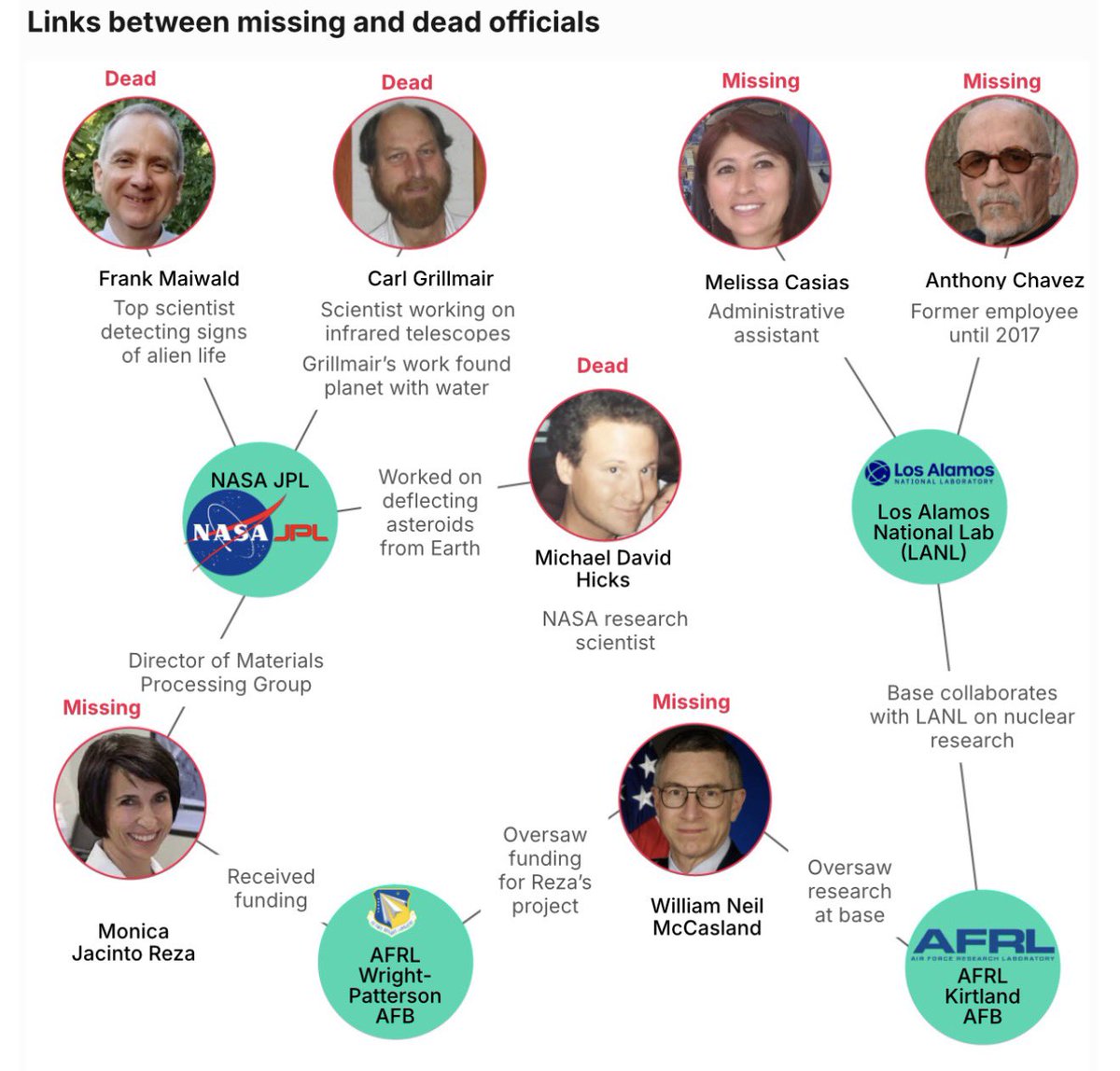
Something unsettling is unfolding—quietly, almost beneath the surface—but loud enough for those paying attention to feel it. Over the past year, reports have emerged of now ten scientists and high-level professionals—some with ties to defense, aerospace, and advanced research—who are either dead or missing under strange circumstances. At first glance, these cases appear isolated. But the deeper you look, the harder it becomes to ignore the possibility that something more coordinated—or at least more consequential—is at play.
Let’s start with what we know.
Authorities in New Mexico, including the Bernalillo County Sheriff’s Department, have confirmed they are at least exploring whether there is any connection between several of these disappearances. One of the most notable figures is retired Air Force General William “Neil” McCasland. A man deeply embedded in military research and development circles, McCasland’s background alone raises questions—not answers. His disappearance, still unresolved, is now being examined alongside others with overlapping professional ties.
One of those ties leads to Monica Reza, described as a “rocket scientist,” who reportedly shared a close professional connection with McCasland. The fact that both individuals vanished within an eight-month window is difficult to dismiss as coincidence. These are not random citizens; they are highly specialized professionals working in fields often adjacent to classified research, advanced propulsion systems, and, potentially, unidentified aerial phenomena.
Then comes the most recent and perhaps most troubling addition to the list: Steven Garcia.
Garcia, a 48-year-old government contractor, disappeared on August 28, 2025, after walking out of his Albuquerque home in broad daylight. According to reports, he was last seen wearing a camouflage shirt and carrying a handgun—details that suggest he may have felt a need for protection. He never returned.
But it’s Garcia’s job that raises eyebrows.
He reportedly worked at the Kansas City National Security Campus, a critical site responsible for producing over 80% of the non-nuclear components used in U.S. nuclear weapons systems. This isn’t just any facility—it’s a cornerstone of national defense infrastructure. Garcia’s role as a property custodian may sound administrative, but sources indicate it involved oversight of tens to hundreds of millions of dollars in equipment, including classified assets. With top-level security clearance and broad access across the facility, Garcia was in a position to know—quite literally—where everything was.
That kind of access comes with both privilege and risk.
Where UFOs Enter the Picture
Now, here’s where things become more speculative—but no less compelling.
In recent years, public interest in UFOs—more formally referred to as UAPs (Unidentified Aerial Phenomena)—has surged. This is due in part to official disclosures from agencies like the Pentagon, as well as high-profile testimonies from whistleblowers. The conversation has shifted from fringe theory to legitimate inquiry, with government acknowledgment that some aerial encounters remain unexplained.
Within that context, individuals like McCasland, Reza, and Garcia occupy a unique intersection: advanced science, military infrastructure, and potential exposure to classified aerospace technologies.
Is it possible that some of these individuals were involved—directly or indirectly—in programs related to reverse engineering, propulsion research, or materials analysis tied to UAPs?
There is no publicly verified evidence confirming that. But the overlap between their professional environments and the types of research long rumored to exist is enough to keep the question alive.
(Another Scientist Has Gone Missing, Bringing the Count up to 10 ) …Reddit
Coincidence, Conspiracy, or Something In Between?
History offers examples that fuel both skepticism and suspicion. During the Cold War, scientists involved in sensitive research were often targets of espionage, surveillance, and, in rare cases, elimination. The stakes were existential. Today, the stakes may be just as high—only the battlefield has shifted.
Could foreign intelligence agencies be targeting individuals with access to sensitive defense technologies? That’s one plausible explanation.
Could internal security breaches, whistleblowing fears, or undisclosed programs be contributing factors? Also possible.
Or are we witnessing a string of tragic but unrelated events being woven together by pattern-seeking minds in an age of information overload?
That’s the question.
The Danger of Silence
What makes this situation particularly troubling isn’t just the disappearances—it’s the lack of clarity. When highly credentialed individuals with access to sensitive information vanish without explanation, it creates a vacuum. And in that vacuum, speculation thrives.
Transparency, even in limited form, is essential. Without it, public trust erodes, and narratives—both grounded and far-fetched—begin to take hold.
Final Thoughts
At this point, there is no definitive evidence linking these ten cases into a single, coordinated pattern tied to UFO research or any covert program. But the convergence of factors—timing, professional overlap, security clearances, and the broader context of renewed UAP interest—makes this more than just a series of unfortunate incidents.
It makes it a story worth watching.
Because whether the truth turns out to be geopolitical, technological, or something else entirely, one thing is certain: when people with access to the unknown begin to disappear, the rest of us are left asking why.
I’m SABear and I approve this message.


 Life is not a Spectator Sport
Leave a comment